


Semi-Hermetic Piston Compressors: Lubricant Degradation and Replacement Standards
Jun 29, 2026
Overview: Lubricant quality is core to the stable operation of semi-hermetic piston compressors. Deteriorated lubricant easily causes component wear and system failure. This article concludes the main deterioration causes and standardized replacement criteria to guide scientific daily maintenance.
Long-cycle operation, abnormal operating temperatures and system contamination are the primary triggers of lubricant degradation in semi-hermetic piston compressors.
Under prolonged high-load operation, lubricants will undergo oxidative deterioration, generating colloidal precipitates and carbon deposits that adhere to piston assemblies, crankshafts and bearing surfaces. Excessive condensation temperature leads to thermal decomposition of lubricant molecules, reducing viscosity and destroying original lubrication performance.
System moisture and impurity infiltration also accelerate deterioration. Unqualified sealing performance allows humid air to enter the internal cavity, causing lubricant emulsification and milky turbidity. Tiny metal wear debris generated by long-term friction will mix into the oil circuit, reducing lubrication uniformity and aggravating internal component abrasion.
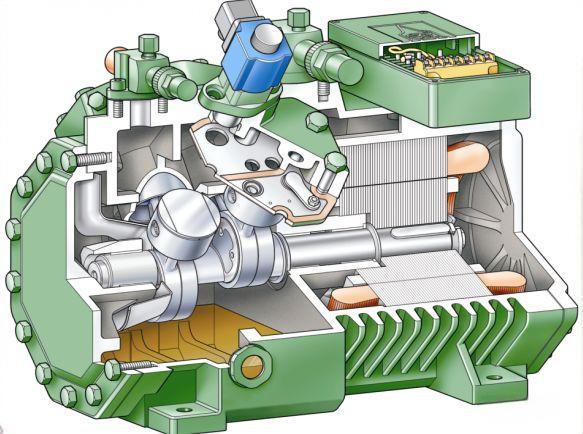
Operators can judge lubricant failure through visual inspection and operational parameter monitoring
Visual indicators: Emulsification, blackening, peculiar smell and visible particle precipitation are typical deterioration signs.
Operational data indicators: Continuous rise of compressor operating temperature, increased vibration and unbalanced operating current all indicate degraded lubrication performance.
Standard Replacement Specification
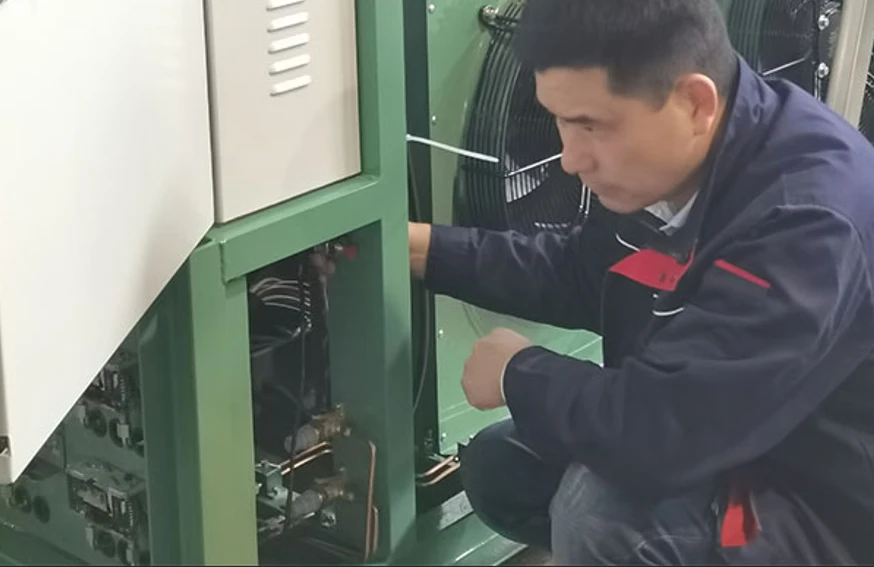
Timely lubricant replacement must follow dual standards of operating hours and actual oil condition.
Cycle standard
Conventionally, semi-hermetic piston compressors require the first oil replacement after 1000 operating hours, and subsequent regular replacement every 2000 hours. For high-temperature, high-humidity and high-load working conditions, the replacement cycle should be appropriately shortened.
Operation specification
During replacement, operators must thoroughly clean the oil tank, filter and oil circuit pipeline to remove residual deteriorated oil and impurities. Only special refrigeration lubricants matching the compressor model and refrigerant type can be used to ensure consistent lubrication performance and long-term operational stability


